
Fixed-price tracking packages
Shopify conversion tracking and server-side measurement
When Shopify, GA4 and your ad platforms disagree, another tracking script rarely fixes it. We review event collection, conversion definitions, server-side handoffs and platform settings to find where the differences start and what can be fixed, whatever tracking app the store uses. Packages and retainers are invoiced by Webgarh in US dollars.
- We reply within 24 hours. The report takes up to one week.
- Invoiced by Webgarh in USD, separately from any Shopify app subscription

Where measurement breaks
What can go wrong with ecommerce measurement?
Browser privacy, ad blockers and consent rules hide purchases from GA4 and your ad pixels. Upsells, subscriptions, Shop Pay orders and refunds are often missed by a basic setup, and some purchases get counted twice. Your reports then undercount what's working, and Meta and Google optimize your budget on partial data.
Missing or delayed purchases
Some purchase events are never sent or accepted, and others arrive late. Reporting systems also differ in when they credit a conversion.
Duplicate events
Several apps, pixels, tag manager setups or browser and server routes can count one purchase more than once when identifiers and deduplication rules are wrong.
Different revenue definitions
Taxes, shipping, discounts, refunds, currency and attribution settings all change what each dashboard shows.
Consent and browser limits
Consent choices and destination rules decide which data may be collected or sent. Server-side tagging does not get around them.
Changes after launch
New checkout flows, migrations, added apps and account changes can quietly alter a setup that once worked.
Four levels
Find your level, and where to start
We place a store by monthly revenue and monthly ad spend together. If the two point to different levels, go with the lower one: what you need from tracking follows your ad spend more than your sales.
Level 1 · Explorer
"Why doesn't GA4 match Shopify?" Revenue under USD 10k and ad spend under USD 1.5k a month. You're running on the free Google and Meta apps, purchases go missing and connections break with nobody to help. The trap is buying attribution tools too early. What you need is a clean, working setup, whichever tracking app you use. Start with a free tracking audit.
Level 2 · Scaler
"Are we missing sales?" Revenue USD 10k to 50k and ad spend USD 1.5k to 7.5k a month. Ad spend is real money now, so every missing sale is a signal your platforms never get. The trap is assuming a basic setup catches everything, when upsells, subscriptions, Shop Pay orders and refunds often slip through. Tracking Audit & Fix finds and cleans up what's wrong. Moving to a new tracking app? We move you across with side-by-side checks.
Level 3 · Maximizer
"Which number do I trust?" Revenue USD 50k to 250k and ad spend USD 7.5k to 40k a month. Meta and Google both claim the same order, and at your budget that error costs real money. Start with Tracking Audit & Fix. From there, a UTM and channel clean-up and a dashboard and attribution build give your team one answer to "which number do we trust?"
Level 4 · Commander
"We want our own data." Revenue USD 250k and up and ad spend USD 40k and up a month. You want tracking in a warehouse you own, joined to the rest of the business, with engineers who build it. That is fractional data engineering, or a data project we scope by conversation. AI decision intelligence
What the free tracking audit covers
Why the totals differ
Why every platform won't show the same number
Shopify records orders. GA4 records analytics events. Google Ads and Meta report conversions under their own attribution windows, date rules and modeling. Two dashboards can differ even when collection works, so the goal is to explain the expected differences and remove avoidable loss or duplication, not to promise identical totals.
We start with what Shopify already gives you, its customer events and the native Google and Meta channels, before adding anything. Where that leaves gaps, we send conversions server-side, so ad blockers and browser limits don't decide what your platforms see. We set that up in the server-side app you already use, or help you pick one that fits your store.
Where most stores start
The free audit's report recommends the next step: usually Tracking Audit & Fix. Other packages follow when a store needs them.
When a store buys a second package within a quarter, the data partner retainer usually fits better: its hours can be spent on any package.
Tracking services and prices
All prices are in US dollars (USD) and invoiced by Webgarh. Scopes, exclusions and timelines are as we quote them; anything outside scope is quoted before work starts. Larger data projects on request: talk to us.
Tracking Audit & Fix
from $199
For stores whose numbers don't add up across Meta, Google and their other platforms, whatever tracking tool they use.
What you get
- A review of every tag and pixel on your store and in your connected accounts: what each one sends, what's duplicated, and what no longer works.
- Your consent setup checked: what happens when a visitor accepts and when they reject.
- Your sales checked by campaign: Shopify against Google Analytics and Google Ads.
- A snapshot of your tracking today.
- A clear list of what to keep, fix or remove, which you confirm before we change anything.
- The clean-up of leftover and duplicate tracking.
- A before-and-after report.
Not included
- Building new tracking, theme redesign, or fixing other apps' own bugs. Larger fixes are quoted first.
Timeline: 3–5 working days after access.
Shopify tracking migration to a new app
$399
For stores moving between tracking apps (for example from Elevar, Analyzify, Littledata or Stape).
What you get
- An inventory of current events and destinations.
- The same coverage rebuilt in the new app.
- About 7 days of side-by-side checks.
- A cut-over, with the old app's tracking switched off.
- A before/after report.
Not included
- Custom events beyond the old setup (quoted as Custom integration), and rebuilding the old app's reports.
Timeline: About 10 working days.
Platform tracking migration
$999
For stores moving to Shopify from another ecommerce platform (WooCommerce, Magento, BigCommerce, Salesforce Commerce Cloud and others), and stores re-platforming their tracking set-up.
What you get
- A map of everything the old store tracked.
- The rebuild on Shopify: events, destinations, conversions and audiences carried over.
- Ad platform conversion settings checked so the platforms keep their learning.
- Side-by-side checks at go-live.
- A note on why numbers before and after the move won't match exactly.
Not included
- The store migration itself (a separate Webgarh project: see Shopify migration), and new reporting.
Timeline: About 2–3 weeks around the go-live date.
Stape integration
$699
For stores that want, or already have, Stape, typically with in-house or agency technical staff.
What you get
- A server-side Google Tag Manager container on Stape.
- GA4 and Google Ads conversion tags, and Meta Conversions API.
- Stape's gateway set-up for Google and Meta where it fits.
- Deduplication checks, and a handover document.
Not included
- The store's Stape subscription, which is paid to Stape directly.
- Ongoing maintenance (a Data partner retainer).
- Platforms beyond Google and Meta, which are quoted.
Timeline: About 7–10 working days.
UTM and channel clean-up
$249
For stores where too much traffic shows as "direct" or "unassigned".
What you get
- Tagging rules for email, SMS, social, affiliates and the CRM.
- GA4 channel groups set up to match.
- A one-page guide.
- A 30-minute walkthrough.
Not included
- Re-tagging past campaigns inside email or ad tools.
Timeline: 1 week.
Dashboard and attribution build
$999
For teams asking "Which number do we trust?"
What you get
- A kick-off to list the decisions the team makes.
- A dashboard in Looker Studio or the client's BI tool, using Shopify, GA4 and ad platform data.
- A "which number answers which question" guide.
- Training for up to 3 people.
Not included
- Media mix modeling, warehouse work, and ongoing changes (those are retainer work).
Timeline: About 3 weeks.
Custom tracking integration
$149–299
What it covers
- $149 for a custom event on a supported platform.
- $299 for a new platform connection, such as an affiliate network.
Timeline: 5 working days after credentials.
Data partner retainer
from $699/month
Works whatever tools the store uses (GTM Assistant, Stape, Elevar, plain GTM).
Tiers
- Essential: $699/month, 30 hours
- Growth: $1,149/month, 48 hours
- Scale: $1,799/month, 76 hours
Terms
- 6-month minimum, then month to month with 30 days' notice.
- Up to 25% of unused hours roll over to the next month only.
- A dedicated Team Lead. Planning and reporting aren't deducted from hours.
- If a month's requests would exceed capacity by more than 10%, this is flagged in writing before work starts.
- Invoiced monthly in advance.
Hours can be spent on any package above. A retainer client doesn't get separate quotes.
Tiers
- Core: $1,299/month, 40 hours
- Growth: $2,400/month, 75 hours
- Dedicated engineer: $3,200/month, About 160 hours
Minimum
- 6 months.
How every package works
Beyond the packages
When a scoped engineering project makes sense
Custom server-side tooling, event rules across several stores, non-standard checkout integrations, data warehouses and independent attribution models fall outside the packages. We define responsibilities and exclusions first, then propose a fixed scope or ongoing support.
Tracking architecture review
Tag inventory, event sources, web and server routes, platform ownership and app overlap.
Measurement specification
Agreed conversion events, identifiers, value definitions, accepted differences and test cases.
Destination build or repair
GA4, Google Ads, Meta Conversions API and other supported destinations, within store and permission limits.
Checks and handover
Comparison with Shopify records, browser and server event checks, deduplication tests and documented remaining differences.

Any store, any tracking app
Webgarh sets up, fixes, audits and migrates tracking whatever app the store uses: GTM Assistant, Stape, Elevar or plain Google Tag Manager. Stores moving to Shopify from another platform are covered too.
Every package is quoted and invoiced by Webgarh, with its scope confirmed before work starts.
Want it kept working every month? See GTM Assistant plans.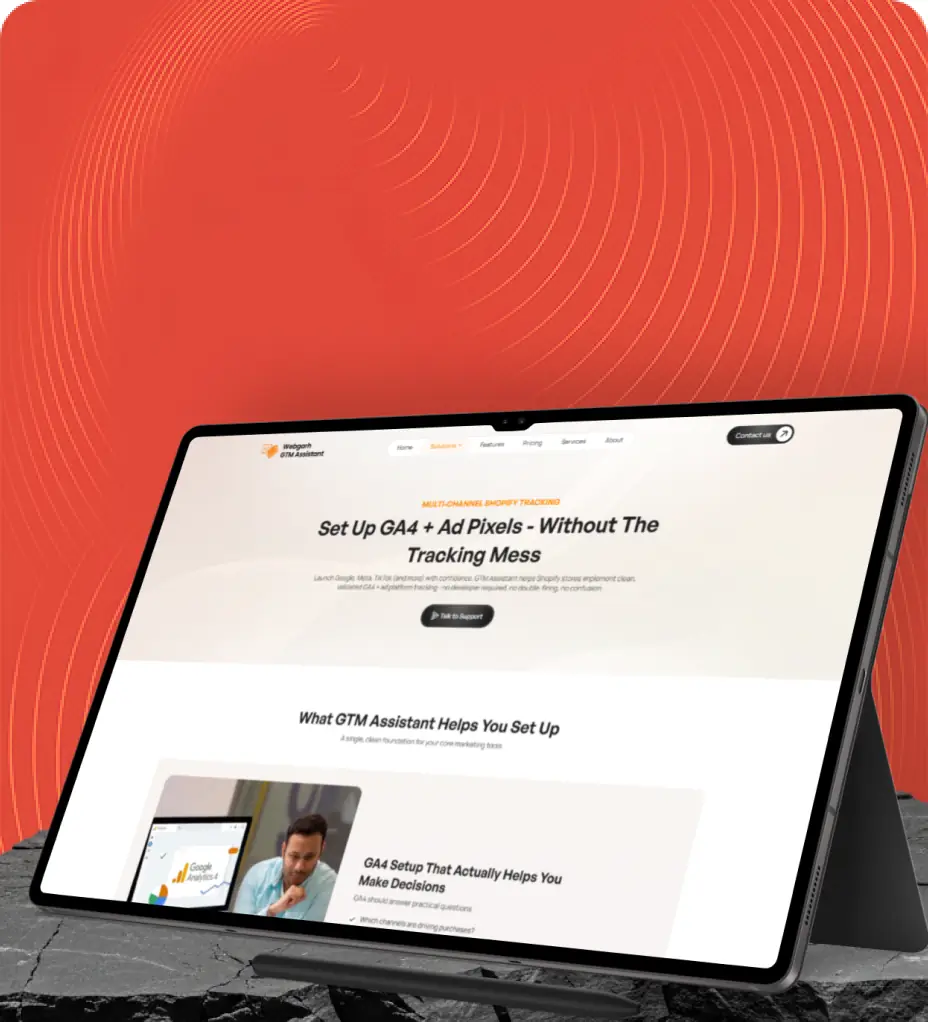
Frequently asked questions
Will GA4 ever match Shopify exactly?
No. Consent choices, ad blockers and different attribution rules mean some gap is normal. The goal is a gap you can explain, with nothing missing that should be there.
Will better tracking raise our ROAS?
It gives your ad platforms complete data to optimize on, and gives you numbers you can trust. We don't promise a return figure; we show you the before and after.
Will you change anything before I agree?
No. We review first, you confirm the findings, then we fix.
What access do you need?
For the free tracking audit: collaborator access through Webgarh's Shopify Partner account, plus Google Ads and GA4 access. Fixed-price work starts when the scope is confirmed and access is in place. Anything outside scope is quoted before work starts.
Do we need GTM Assistant to use these services?
No. The packages and the data partner retainer work with whichever tracking app or set-up the store uses, including GTM Assistant, Stape, Elevar and plain Google Tag Manager.
How are these services billed?
Webgarh invoices them, in USD, separately from any Shopify app subscription.
Can retainer hours be spent on a package?
Yes. Data partner retainer hours can be spent on any package on this page. A retainer client doesn't get separate quotes.
Does server-side tracking guarantee every order shows up in our ad accounts?
No. Server-side sending gives more control over supported events, but consent choices, platform acceptance, modeling and attribution rules still affect what each platform reports.
Connected services
The next question may sit in another system
These services often sit next to this one in a real ecommerce decision. Start with the one that usually needs clarifying next.
First-party data and privacy
Consent, identity and permitted data use.
Which customer data can be linked, where it may go and how consent changes what each destination receives.
Explore first-party data and privacyMarketing attribution
Reporting differences, explained.
Once event quality is known, compare how each platform defines conversions, windows and credit.
Explore marketing attributionAll Data & Intelligence services
Five connected services.
Tracking, privacy, attribution, post-purchase outcomes and AI-assisted analysis.
See Data & Intelligence
Start with a free tracking audit
We compare the last 30 days of Shopify orders with GA4 and Google Ads, flag double counting and send a written report. We reply within 24 hours. The report takes up to one week.
