
Redesign your Shopify store for better conversion, usability and growth
We fix the structure behind your store along with the look, so the new design keeps paying off after launch.
- Shopify Select Partner
- 80+ engineers since 2010
- 4.9 from 28 Shopify Partner Directory reviews

Why Shopify redesign matters
A redesign is not just about how your store looks it shapes how it performs, scales, and supports day-to-day operations. A structured redesign helps reduce repeated fixes, theme patches and costly rebuilds later by addressing underlying issues early. A well-developed.
How easily customers navigate the store
How flexible your content and merchandising become
How well the mobile experience performs
How quickly new campaigns can be launched
When a redesign is the right call
Customers struggle to find products or drop off on mobile.
Your team needs a developer for every campaign page.
The theme can't use Online Store 2.0 sections.
Apps have piled up and slow the store.
The brand has moved on and the store no longer reflects it.
What we change
- Navigation and collection structure
- Product page hierarchy
- Mobile journeys and checkout path
- Theme code and app footprint
What we protect
- URLs, redirects and metadata, so rankings hold
- Tracking and analytics events
- Integrations, reviews and customer accounts
- Day-to-day operations during the switch
Redesign without losing what works
Before we change anything, we benchmark the current store on speed, conversion and search visibility. We keep what performs and rebuild what doesn't. Native Shopify features replace apps wherever they can, which cuts load time and monthly app spend. After relaunch we compare the new store against that baseline.

How a redesign keeps what works
Webgarh Shopify store redesign framework
We approach every Shopify redesign as a system-level improvement not just a visual update. Each stage is designed to reduce friction, improve manageability, and support better conversion outcomes.
Store audit & experience review
We start by evaluating how your store performs across navigation, product pages, mobile usability and overall user flow. Navigation and collection structure issues; mobile usability gaps; product page performance and clarity; content gaps and weak conversion paths.
Store architecture & content planning
A redesign works best when the future structure is clearly planned. Collection and navigation hierarchy; product page structure and content flow; metafields, metaobjects, and reusable sections; filtering, search behavior, and internal linking.
UX & theme redesign
We focus on simplifying the experience while improving usability and clarity. Homepage and key landing page redesign; collection and navigation improvements; product page hierarchy and layout; mobile-first UX and checkout flow.
Theme build & performance improvements
We rebuild or optimize the theme with a focus on scalability and maintainability. Scalable theme architecture; reusable components and structured code; reduced app dependency; site speed and mobile performance optimization.
App & integration review
A redesign is an opportunity to remove unnecessary complexity. Audit of existing apps and tools; removal of duplicate or unnecessary apps; review of search, reviews, and subscriptions; CRM, ESP, and analytics integration alignment.
QA, testing & launch validation
We test the redesigned store across real scenarios to reduce post-launch issues. Responsive testing across devices; navigation, filters, and product flow validation; cart and checkout testing; performance and integration checks.
Post-Launch refinement
Launch is only the first step. We support early-stage optimization and adjustments. Post-launch issue resolution; behavior-based design refinements; merchandising and content updates; performance monitoring and tracking validation.
Common risks in Shopify redesign projects
Most redesign issues don't come from design itself they come from missing structure. When underlying problems are not addressed, the store may look better but perform worse over time.
Outcomes of a structured Shopify redesign
A well-planned Shopify redesign does more than improve appearance. It simplifies how customers interact with your store while making it easier for teams to manage and scale.
Product discovery becomes easier
Customers can browse collections, filters, and product categories with less friction.
Conversion paths become clearer
Improved layouts and content hierarchy help users move more confidently from browsing to purchase.
Merchandising becomes easier to manage
Reusable templates and structured sections reduce manual effort and simplify campaign execution.
Mobile usability improves
The storefront becomes easier to navigate, browse, and purchase from on smaller screens.
Internal teams gain more flexibility
Marketing and content teams can update pages without depending heavily on developers.
The storefront becomes easier to scale
New products, collections, and campaigns can be added without disrupting the overall experience.
Start with a Store Audit
Not sure how much needs to change? A Store Audit reviews your UX, theme, apps, speed and tracking, and tells you whether a refresh, a partial redesign or a full rebuild makes sense.
Book a Store AuditRedesigns we've delivered
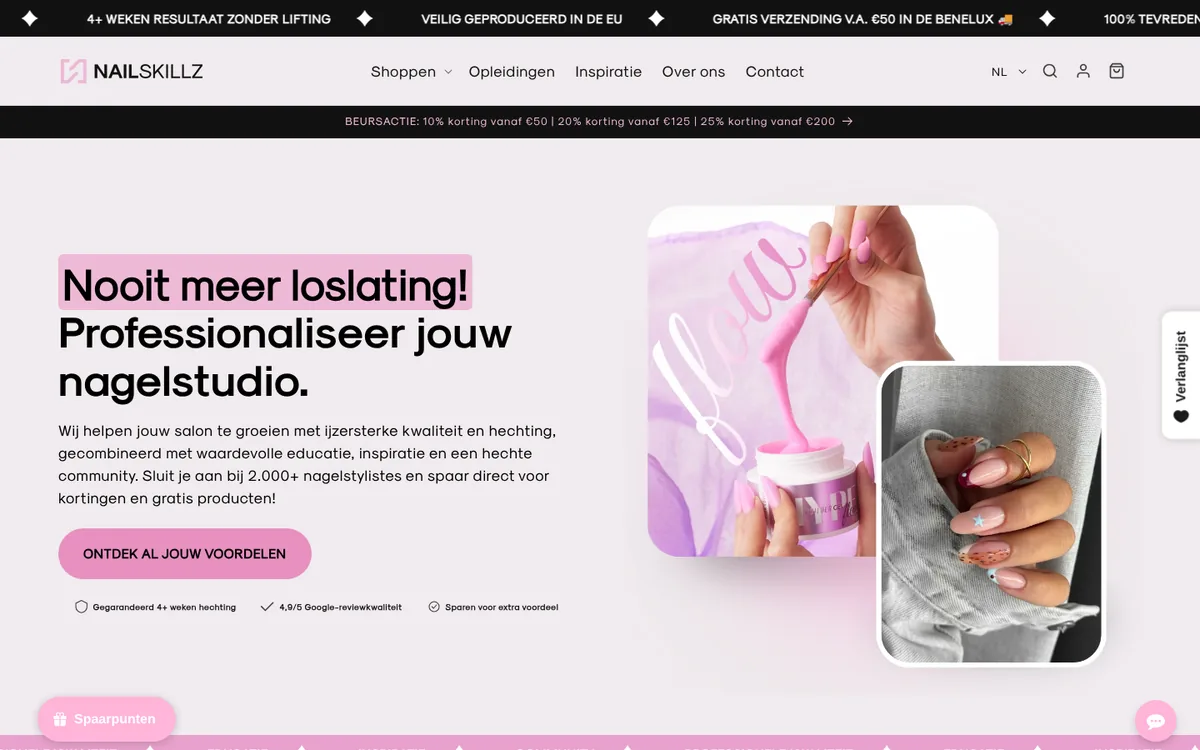
Redesign
every template, plus ongoing support
NailSkillz
A complete Shopify redesign for a Dutch nail products brand
Read the case study
Redesign
luxury fashion store
Gemy Maalouf
Shopify redesign refinement for a luxury fashion store
Read the case study
B2B
wholesale channel on Shopify Plus
Simply Nootropics
Shopify Plus B2B with account-based ordering
Read the case study
Frequently asked questions
How long does a Shopify redesign usually take?
It depends on the size of the store, number of templates, catalog complexity, and required functionality. A structured redesign usually takes several weeks because planning, testing, and validation are included.
Can you redesign only certain parts of the store?
Yes, Some businesses only redesign the homepage, product pages, or mobile experience first. Others redesign the full storefront.
Will a redesign affect SEO?
It can if URLs, content, metadata, or internal linking are changed without planning. We typically review SEO continuity during the redesign process to reduce unnecessary risk.
Do we need a new theme?
Not always. Some stores can improve significantly through restructuring and optimization of the existing theme. Others benefit from a new theme or full rebuild if the current setup is too restrictive.
Can the redesigned store support future growth?
Yes, when planned correctly. We redesign stores with future merchandising, campaigns, product expansion, and operational scale in mind.
How long does a redesign take?
It depends on the number of templates and how much structure changes. A typical full redesign takes four to six weeks, and we confirm the timeline after the audit.
Will our tracking still work after relaunch?
Yes. We map every analytics and ad event before the switch and validate them after launch.
More store build services
Theme development
Custom Shopify Online Store 2.0 themes built from reusable sections and clean code, fast on mobile and easy for your team to manage.
See how we do itPOS & retail
Shopify Markets, expansion stores, POS and shared inventory, planned so every storefront runs on connected operations.
See multi-store systemsNew store launch
A fixed-scope Shopify launch package: catalog, theme, apps, tracking and QA planned up front, so your store opens ready to sell and ready to grow.
See how we do itAll store build services
New Shopify and Shopify Plus stores, theme builds, redesigns and POS, built on Shopify's own stack so they stay fast and easy to run.
See store build services
Redesign your Shopify store with the right structure
Start with a Store Audit, or tell us what you want to change. You'll hear back within 24 hours.
Book a Store Audit